

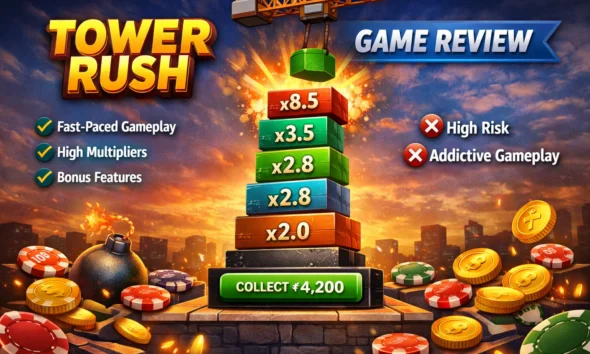
In the crowded landscape of mobile strategy gaming, few titles deliver on their promises with the intensity of Tower Rush. Developed by Solar Forge Games and published by Freedom Games, this entry into the tower defense genre has carved out a niche for players who are tired of passive, single-player experiences where enemies follow predictable, scripted paths. Instead, Tower Rush offers a heart-pounding, Player-vs-Player (PvP) tug-of-war that redefines what it means to defend your turf .
If you search for “Tower Rush” online, you might initially stumble upon a confusing mix of results—some pointing to online slot machine mechanics with “Block Build Modes” and RTP statistics. However, the core title that has been taking over iOS and Android devices in 2025-2026 is a fast-action strategy game. It is a real-time contest where two players face off on a shared battlefield, racing to destroy the enemy’s base while protecting their own .
Here is everything you need to know to go from a novice builder to a strategic commander.
The Core Concept: A Shared Battlefield
Unlike traditional tower defense games where you hoard resources to survive a horde of AI enemies, Tower Rush introduces a living, breathing opponent. The premise is simple: you summon units that march from your side of the map to the left, attempting to chip away at the enemy’s health. Simultaneously, your opponent is doing the same to you.
This creates a dynamic “tug-of-war” . The battlefield is not static; the line of control shifts constantly based on who is spending their resources more wisely. One moment you might be pushing toward the enemy tower with a horde of melee units; the next, you are scrambling to place a defensive tower to stop a flanking maneuver from an enemy air unit.
Matches are intentionally short, typically lasting between 2 to 4 minutes. This rapid pace means there is no room for hesitation. Tower Rush truly lives up to its name, forcing players to “rush” to build towers as fast as their fingers and resources will allow .
Gameplay Mechanics: The Tug-of-War
To succeed in Tower Rush, you must master three distinct pillars of gameplay: Economy, Troop Composition, and Tower Placement.
1. Resource Management (The Economy)
Gold is the lifeblood of your war effort. It accumulates automatically over time, but it caps out if you don’t spend it. The core strategic decision you face every few seconds is: Do I summon another unit to push the lane, or do I save up to upgrade my income limit?
Upgrading your “Money Bar” increases the amount of gold you can hold and the speed at which it generates. A common rookie mistake is summoning troops constantly without upgrading the economy. While this creates an early swarm, it often fizzles out against a savvy opponent who upgraded their income first and can now afford more expensive, higher-tier units .
2. The Cards and the Deck
You do not have access to every unit at once. Tower Rush utilizes a deck-building system where you select which warriors, spells, and towers you bring into battle . This adds a layer of meta-strategy.
- Troops: These are your offensive units that walk toward the enemy base. They range from cheap “cannon fodder” swordsmen to powerful mages and flying units.
- Towers: These are defensive structures placed on your side of the field to kill enemy troops.
- Spells: Instant effects, such as healing your guardian or nuking a cluster of enemy units.
The synergy between these cards is vital. For example, you might have a “Guardian” unit—a super-troop that can turn the tide of a skirmish. Knowing when to deploy your Guardian versus when to save that mana for a defensive tower is the mark of an expert player .
3. The Talent System
One of the most unique features of Tower Rush is the Talent system. As you progress and win matches, you earn Talents. These are permanent buffs that shape your playstyle. For instance, a talent might reduce the hiring cost of support units by 14% or give spellcasters a 10% chance to double-cast their spells.
This system allows for high replayability. You can build a “Zoo” strategy focusing on cheap, spammable units, or a “Tech” strategy focusing on expensive, high-damage mages .
Advanced Strategy: Placement and Prediction
While mashing the “summon” button might win you the first few matches, climbing the leaderboard requires precision, specifically in tower placement.
The Chokepoint Principle
Do not place your towers at the very start of the path. In the words of high-level players, placing a structure right at the spawn point is a “death sentence” . Instead, look for the bend in the road or the chokepoint. This is where the path narrows or turns. Placing a tower here maximizes the “dwell time”—the amount of time the enemy spends in your tower’s firing range .
The 75% Rule
Many players waste gold upgrading towers prematurely. A popular strategy among veterans is the “75% Rule.” Wait until the enemy wave has pushed approximately 75% of the way down the lane before hitting the upgrade button. This ensures you are maximizing your gold efficiency and responding to the immediate threat rather than over-investing in a spot that might not be the main battleground in 10 seconds .
Reading Enemy Patterns
Tower Rush is not a game of chance (unlike the slot versions found under similar names). Enemy waves follow predictable intervals based on time. For example, a heavy unit might spawn precisely 2 seconds after a light unit. If you learn these rhythms, you can pre-place a “Sniper” tower specifically timed to nail that heavy unit the second it spawns, rather than wasting ammo on the small fries .
Progression and Customization
The game features a robust progression system. Winning matches earns you experience, unit tokens, and crystals. As your player level increases, your entire army gains base stats—a level 2 army will genuinely feel stronger than a level 1 army .
The “Unlock Choice System” puts you in control. Instead of random loot boxes (though the game does contain loot boxes as noted in its age rating), you often get to choose which new card is added to your pool, allowing you to build the specific army you want to play .
How to Avoid the “Arnaque” (The Scam Confusion)
A quick note for new players searching for this game: you may encounter the term Tower Rush Arnaque (French for “scam”). This generally refers to a confusion between the legitimate PvP strategy game and various online casino/slot games that use the “Tower” aesthetic to simulate building floors for cash bets .
The legitimate Tower Rush PvP game by Solar Forge Games is free-to-play on the App Store and Google Play. It does not promise “120% RTP” or “instant cashouts.” It promises fast-paced strategic combat. If you are looking for a slot machine, you are in the wrong place. If you are looking for a competitive rush, download the app with the vibrant fantasy art style .
Verdict: Is It Worth the Download?
Yes. Tower Rush successfully solves the biggest problem with mobile strategy games: boredom. By forcing real-time PvP interaction, it eliminates the predictability of standard tower defense.
The Good:
- Fast-Paced: Matches are quick, making it perfect for mobile gaming on the go.
- Strategic Depth: The combination of economy, talents, and deck-building offers genuine replayability.
- Fair Progression: The talent system allows for diverse playstyles.
The Caveats:
- Intensity: Because it is real-time, it can be stressful. There is no “pause” button to plan your next move.
- In-App Purchases: As a free-to-play title, there are in-app purchases (up to $99.99 for gem packs), which can give paying players a speed advantage in unlocking cards .
Tower Rush is a breath of fresh air for strategy fans. It strips away the tedious waiting of the genre and replaces it with a frantic, exciting race to the finish. Just remember: watch your chokepoints, upgrade your economy, and never stop rushing.