

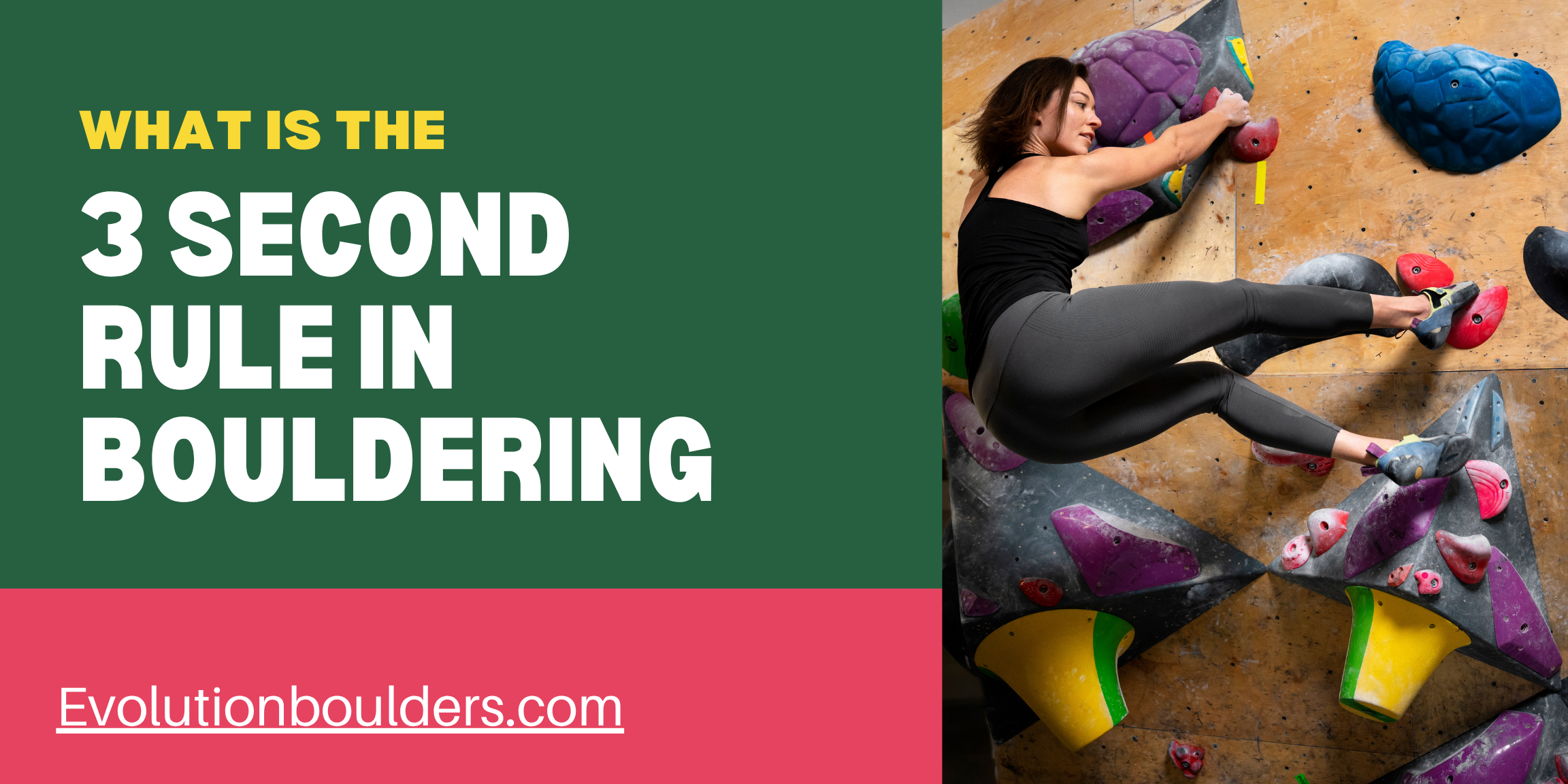
Studies show that over 70% of beginner boulderers quit within the first year. One of the biggest reasons? They never learn proper technique. They rely on raw strength, burn out fast, and get frustrated when they stop progressing. The 3 second rule in bouldering is one of the simplest concepts that can change how you climb. It forces you to slow down, think about your body, and move with purpose. If you have been struggling to send problems or feeling like you hit a wall in your progress, this one rule might be exactly what you need.
This guide breaks down everything about the 3 second rule in bouldering. You will learn what it is, why it works, how to practice it, and how it connects to the bigger picture of becoming a better climber. Whether you just started climbing last week or you have been at it for a few months, this information will help you build a stronger foundation.
What Exactly Is the 3 Second Rule in Bouldering?
The 3 second rule in bouldering is simple. After you make each move on the wall, you pause and hold your position for at least three seconds before making the next move. That is it. No rushing. No frantic grabbing for the next hold. You stop, settle into your position, and then move again.
This sounds easy, but it is surprisingly hard in practice. Most beginners climb like they are in a race. They grab one hold and immediately reach for the next. Their feet swing around. Their body tenses up. They burn through energy like a car with the gas pedal stuck to the floor.
The 3 second rule forces you to fight that urge. It teaches you to find balance at every point on the wall. When you hold a position for three seconds, you quickly learn whether your body placement is good or bad. If you cannot hold still for three seconds, something is off. Maybe your feet are in the wrong spot. Maybe your hips are too far from the wall. Maybe you are gripping the holds way too hard.
Think of it like learning to drive. A new driver grips the steering wheel with white knuckles and overreacts to every little thing. An experienced driver stays calm and makes smooth adjustments. The 3 second rule helps you become the experienced driver on the wall.
Why the 3 Second Rule Works So Well for Beginners
There is real science behind why pausing works. When you climb without stopping, your body runs on instinct. Your brain does not have time to process what is happening. You make sloppy decisions, waste energy, and develop bad habits that become harder to fix later.
Pausing for three seconds gives your brain a chance to catch up. You can feel where your weight sits. You can notice if your arms are straight or bent. You can look at the next hold and plan your move before you commit to it. This tiny window of time turns mindless climbing into deliberate practice.
Research on motor learning shows that slowing down a skill during the learning phase leads to faster long term improvement. Athletes in almost every sport use this principle. Baseball players practice slow swings. Martial artists drill techniques at half speed. The 3 second rule is the bouldering version of this same idea.
Another reason it works so well is that it builds isometric strength. When you hold a position on the wall, your muscles work hard even though you are not moving. Your fingers, forearms, core, and legs all engage to keep you in place. Over weeks and months, this builds the kind of strength that actually matters for climbing. Brute force can only take you so far. Controlled strength takes you much further.
How This Rule Improves Your Footwork
Bad footwork is the number one problem beginners have. Most new climbers focus entirely on their hands. They look up, grab holds, and let their feet do whatever they want. This is backwards. Good climbing starts from the feet up.
The 3 second rule shines a spotlight on your feet. When you try to hold a position for three seconds, you instantly notice if your feet are placed poorly. Sloppy foot placement means you wobble, slip, or feel like you are about to fall. Good foot placement means you feel solid and stable.
During each three second pause, look down at your feet. Are you standing on the tips of your toes or smearing the whole bottom of your shoe on the hold? Are your feet directly below your center of gravity or are they off to one side? These are things you never notice when you are rushing through a problem.
Over time, this rule trains you to place your feet with precision. You start stepping on holds with intention instead of just throwing your feet wherever they land. This single change makes a massive difference. Precise footwork takes weight off your arms, saves energy, and lets you climb longer before getting pumped. Many experienced climbers say that footwork is responsible for 70% or more of good climbing technique.
How It Builds Better Body Positioning
Body positioning is about where your hips, shoulders, and center of gravity sit relative to the wall. Beginners almost always climb square to the wall. They face it straight on with both hands and both feet spread out. This works for easy problems but falls apart quickly on harder ones.
When you pause for three seconds on each move, you start to feel how different body positions change your balance. Try turning your hips toward the wall with one hip close and one shoulder rotated out. You will probably notice that reaching overhead feels easier. Try dropping your knee inward and you will find new stability on small footholds.
The pause gives you time to experiment. Without it, you just power through each move and never learn these subtle adjustments. With it, you become aware of your body in a way that speeds up your growth as a climber.
One of the most important things you will learn through this practice is the concept of keeping your arms straight. Bent arms burn out fast because your biceps have to work constantly. Straight arms let your skeleton carry the weight instead of your muscles. During your three second pauses, consciously straighten your arms and let your weight hang from your bones. This alone will add minutes to your climbing endurance.
The Connection Between the 3 Second Rule and Energy Conservation
Energy management separates good climbers from great ones. A beginner might be just as strong as an intermediate climber but gas out in half the time. The difference is efficiency. The 3 second rule teaches efficiency from the ground up.
When you slow down and hold each position, you learn which positions cost energy and which ones save energy. A rest position on the wall might feel impossible at first, but with practice you learn to find spots where you can shake out your arms and let your muscles recover. These micro rests add up over the course of a climb.
Speed climbing has its place, but most beginner and intermediate problems reward smooth and controlled movement. Think about watching a really good climber. They look relaxed. They flow from hold to hold. They make hard climbs look easy. That smoothness comes from thousands of hours of controlled practice. The 3 second rule starts building that smoothness on day one.
Each time you pause, ask yourself a question. Could I stay here for ten seconds if I needed to? If the answer is no, your position needs work. If the answer is yes, you are on the right track. Over time, your answer will be yes more and more often, even on harder problems.
How to Practice the 3 Second Rule Step by Step
Getting started with this rule is straightforward. Here is a practical way to work it into your climbing sessions without overcomplicating things.
Start with easy problems. Pick routes that are well below your limit. If you normally climb V3, drop down to V0 or V1. The goal is not to challenge your strength right now. The goal is to challenge your control. Easy problems let you focus entirely on technique without worrying about falling off.
Climb to the first hold and stop. Count to three in your head. During those three seconds, check your feet, check your body position, and straighten your arms. Then make your next move. Stop again. Count to three. Repeat this process for the entire problem.
At first, this will feel painfully slow. Other climbers might give you weird looks. That is fine. You are building a skill that will pay off for years. Speed will come naturally later. Right now, control is the priority.
After a few sessions with easy problems, start applying the rule to moderate problems. You will find it much harder to hold positions for three seconds when the holds are smaller or the angles are steeper. That difficulty is the point. It shows you exactly where your technique breaks down and where you need to improve.
Do this for at least four to six weeks. Most climbers who commit to this practice see noticeable improvement in their climbing within a month. Their movement becomes smoother, their endurance improves, and they start sending problems that used to feel impossible.
Common Mistakes Beginners Make with This Rule
Even a simple rule can be done wrong. Here are the most common mistakes people make when trying the 3 second rule in bouldering.
The first mistake is only doing it once and then forgetting about it. This rule works through repetition. Doing it on one session and then going back to speed climbing will not help. You need to make it a consistent part of your warm up routine at minimum. Ideally, practice it throughout your entire session for the first month or two.
The second mistake is holding positions with bad form. Pausing for three seconds while death gripping every hold and keeping your arms bent does not teach you anything useful. The pause should be a chance to find the most efficient position possible. Relax your grip. Straighten your arms. Shift your weight onto your feet. If you are shaking and straining during the pause, adjust until you find something more sustainable.
The third mistake is skipping easy problems. Ego is real in climbing gyms. Nobody wants to be seen on the easy wall. But easy problems are where you build technique. Hard problems force you into survival mode where clean technique goes out the window. Swallow your pride and spend time on routes below your level. Your future climbing self will thank you.
The fourth mistake is being too rigid with the count. Three seconds is a guideline, not a law. Sometimes two seconds is enough. Sometimes you should hold for five or even ten seconds to really dial in a tricky position. Use the three second number as a starting point and adjust based on what your body tells you.
When to Move Beyond the 3 Second Rule
The 3 second rule is a training tool, not a permanent climbing style. As you progress, you will not need to pause on every single move. The habits it builds will become automatic. You will naturally place your feet better, keep your arms straighter, and find efficient body positions without thinking about it.
Most climbers find that after two to three months of consistent practice, the rule has done its job. They can then shift to using it selectively. Maybe they use it during warm ups, on new problems they are reading for the first time, or on crux moves where precision matters most.
Some advanced boulderers revisit the rule whenever they feel their technique getting sloppy. Climbing is one of those sports where bad habits creep in slowly. You do not notice them until one day you realize you have been muscling through problems instead of climbing them cleanly. Going back to the 3 second rule for a few sessions can reset your technique and remind your body what controlled movement feels like.
There are also situations where pausing is the wrong approach. Dynamic moves, where you need momentum to reach a distant hold, require speed and commitment. Campus moves and jumping between holds do not work with a pause in the middle. As you advance, you will learn when to be static and when to be dynamic. The 3 second rule applies to static movement. Do not try to force it onto moves that require speed.
How the 3 Second Rule Connects to Reading Problems
Reading a problem means looking at the holds before you climb and planning your sequence of moves. Good problem reading saves enormous amounts of energy because you are not guessing while you are on the wall. The 3 second rule strengthens this skill indirectly.
When you pause on each hold, you develop a habit of looking ahead. During those three seconds, you naturally start scanning for the next hold and thinking about how to get there. Over time, this habit transfers to your ground level problem reading. You start seeing sequences more clearly before you even touch the wall.
Many coaches recommend combining the 3 second rule with deliberate problem reading. Before you start a climb, stand at the base and trace the path with your eyes. Identify each hold. Think about which hand goes where. Consider where your feet will be. Then climb it with the three second pauses to see if your plan was right.
This combination of planning and controlled execution is how intermediate and advanced climbers approach problems. Starting this habit early gives you a significant advantage over climbers who just jump on the wall and figure it out as they go.
Physical Benefits You Will Notice
Beyond technique, the 3 second rule delivers real physical benefits that make you a stronger climber.
Your grip endurance will improve. Holding positions on the wall for extended periods trains your forearms to sustain effort over time. This is different from the short burst strength that most beginners develop. Long sustained grip strength is what lets you climb multiple problems in a session without your forearms turning to concrete.
Your core strength will increase. Keeping your body still on the wall requires constant core engagement. Every pause is essentially a core workout. A strong core helps you keep your feet on the wall during steep climbs, control your body during overhangs, and maintain tension through difficult sequences.
Your shoulder stability will improve. Hanging from holds with straight arms in controlled positions trains the stabilizer muscles around your shoulder joints. These small muscles protect you from injury and give you more control during reaches and crosses. Shoulder injuries are common in climbing, and building stability early is one of the best preventive measures you can take.
Your legs will get stronger in a climbing specific way. Pushing up from footholds and holding positions with your legs engaged builds the kind of lower body strength that matters on the wall. This is not the same as squatting heavy weight at the gym. It is balance and control oriented strength that helps you trust your feet and use them effectively.
Mental Benefits That Go Beyond the Wall
Climbing is as much a mental sport as a physical one. Fear, frustration, and impatience are the biggest enemies of progress. The 3 second rule helps with all three.
Pausing on the wall teaches patience. You learn to sit with discomfort instead of rushing away from it. This patience transfers to how you approach hard problems. Instead of getting frustrated and giving up after two attempts, you become more willing to slow down and work through difficulties.
The rule also reduces fear. When you practice holding positions and proving to yourself that you can stay on the wall, your confidence grows. You start trusting your body more. Falls feel less scary because you know you have control. This is especially helpful for beginners who struggle with the fear of falling on their bouldering journey.
Focus is another mental skill that improves. Climbing with intention and pausing deliberately requires concentration. Your mind cannot wander when you are counting to three and checking your body position. Over time, this trains your ability to stay present and focused during climbs. Climbers often describe a flow state where everything else disappears and only the wall exists. The 3 second rule helps you get closer to that state.
What Experienced Climbers Say About This Technique
Talk to any experienced boulderer and they will tell you that controlled climbing beats powerful climbing almost every time. Many top climbers credit their early focus on technique as the main reason they progressed faster than their peers.
Professional climbing coaches frequently use the 3 second rule or similar pausing drills with their students. It is one of the most commonly recommended exercises for beginners in climbing instruction books and training programs. The consensus among coaches is clear. Slowing down early leads to faster improvement in the long run.
Some gyms even incorporate this rule into their beginner classes. Instructors ask new climbers to pause on each hold and describe what they feel. Are their arms straight? Where is their weight? Can they move one hand without falling? These simple questions during a three second pause reveal more about a climber’s technique than any amount of verbal instruction.
If you climb with more experienced partners, ask them to watch you practice the 3 second rule and give feedback. Having another set of eyes on your body position is incredibly valuable. They will spot things you cannot feel, like a hip that is too far from the wall or a foot that is not weighting properly.
Putting It All Together: Your Action Plan
You now know what the 3 second rule in bouldering is, why it works, and how to practice it. Here is a simple plan to start using it immediately.
During your next gym session, warm up on the easiest problems available. Climb each one using the 3 second rule. Focus on feet first, then body position, then arm straightness. Do this for at least 20 minutes before moving to harder climbs.
For the next four weeks, use the rule on every problem that is at or below your comfortable climbing grade. Keep a mental note of what you discover during each pause. What feels stable? What feels shaky? Where do you tend to over grip?
After four weeks, start applying the rule selectively. Use it on warm ups, on new problems, and whenever you feel stuck on a project. Let the habits run on autopilot for everything else.
Check in with yourself every month. Are you climbing more smoothly? Do your forearms last longer? Are you sending problems that used to shut you down? If the answers are yes, the rule is working.
Conclusion
The 3 second rule in bouldering is not flashy. It will not make for exciting gym videos. But it is one of the most effective tools any beginner can use to build real climbing skill. It teaches footwork, body positioning, energy management, and mental focus all at once. The best part is that it costs nothing and requires zero special equipment. Just a willingness to slow down and pay attention.
Start using it at your next session. Give it a real commitment for at least a month. You will be surprised at how much your climbing improves from something so simple. The wall rewards patience and precision far more than it rewards raw power. The 3 second rule teaches both.