

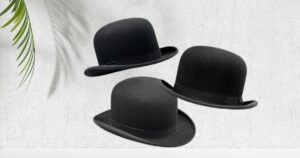
In the grand lexicon of iconic headwear, few pieces are as instantly recognizable, yet as profoundly misunderstood, as the bowler hat. To the modern eye, it is a shorthand for the stuffy bureaucrat, the silent film comedian, or the faceless city gent. It conjures images of Charlie Chaplin’s Little Tramp, Stanley Kubrick’s violent droogs in A Clockwork Orange, or a sea of identical men in pinstripes marching into a London fog.
But this simple, hard-shelled hat is a masterpiece of paradoxical design. It was born from a need for protection on a horse, yet it became the uniform of the urban desk worker. It was a symbol of Victorian respectability, yet it was later adopted as an icon of surrealist rebellion. The story of the bowler is not just a tale of fashion; it is a 150-year history of class, industry, and the ever-shifting meaning of the clothes we wear.
A Hat for the Country (Not the City)
The bowler’s origin story is a classic example of necessity breeding invention. The year is 1849. A young British aristocrat and landowner named Edward Coke, the younger brother of the 2nd Earl of Leicester, required a new type of hat for his gamekeepers at Holkham Hall in Norfolk. The traditional top hat, while elegant, was impractical for hunting. It was tall, easily knocked off by low-hanging branches, and offered little protection if a keeper took a fall from a horse.
Coke visited Lock & Co., the legendary hatters on St. James’s Street in London. He requested a hat that was hard, durable, and low-crowned enough to stay on a man’s head in a thicket. It needed to be resilient enough to protect the wearer from a blow, but not so stiff as to be uncomfortable. He didn’t want a floppy cloth cap; he wanted armor for the head.
The commission was passed to Thomas and William Bowler, a family of hatters in Southwark. Their solution was revolutionary. They took a felted fur (usually beaver or rabbit) and shellacked it to an almost plastic hardness, then shaped it into a rounded, low dome. The brim was short and rolled up slightly on the sides. When Coke traveled to London to collect the first prototype, he famously tested it by placing it on the floor and stomping on it. The hat didn’t buckle; it held its shape. Coke paid his 12 shillings on the spot.
The “Bowler” hat—or as it was originally known, the “Coke” hat—was born. It was a triumph of engineering. For the gamekeepers, it was the perfect blend of the working cap’s practicality and the top hat’s dignity.
The Ascent of the “Derby”
While the British called it the Bowler, the hat would find its most fervent commercial success in the United States under a different name: the Derby. The exact reason for the name change is murky, but it likely derives from the 12th Earl of Derby, a contemporary politician and sportsman, or from the Epsom Derby horse race, where the hat became a favorite among the sporting gentry.
Regardless of the name, the hat crossed the Atlantic in the 1860s and exploded in popularity. In the American West, it was the hat of choice for outlaws and lawmen alike. It was more practical than the wide-brimmed cowboy hat for riding in a stagecoach (it didn’t get blown off by the wind) and offered better protection in a bar fight than a soft cap. Butch Cassidy and the Sundance Kid, Billy the Kid, and Bat Masterson were all known to favor the Derby. In a fascinating cultural flip, a hat designed for an English aristocrat’s servants became the headgear of the wild, untamed American frontier.
Back in Britain, the industrial revolution was in full swing, and a new class of worker was emerging: the clerk. The bowler, perched halfway between the top hat of the owner and the cloth cap of the laborer, became the perfect symbol of the rising middle class. It was respectable enough for the office, durable enough for the daily commute on a crowded, smoky omnibus, and affordable enough for a man on a salary.
By the 1880s and 90s, the bowler was ubiquitous. It was the hat of the City of London. Every morning, tens of thousands of clerks, brokers, and managers would pour out of railway stations like Liverpool Street and London Bridge, a dense forest of dark, hard domes bobbing their way to work. It was the uniform of an empire’s administrative engine.
The Golden Age and the Art of the Bowler
The early 20th century was the bowler’s golden age. It reached its peak of social ubiquity in the 1920s, 30s, and 40s. It was no longer just a worker’s hat; it was the gentleman’s hat for day wear. It was worn with morning coats, lounge suits, and even casual attire. The rules of hat etiquette were strict: a gentleman doffed his bowler to a lady, removed it in an elevator, and never, ever wore it indoors.
The bowler’s shape also became a canvas for subtle personal expression. The height of the crown, the curl of the brim, and the width of the ribbon band could vary. A deeper curve in the brim was considered more rakish, while a flatter brim was business-like. Men would have their bowlers hand-finished by their hatter to achieve a unique silhouette. It was a form of non-verbal communication, a silent code of status and personality.
This was the era of the bowler in film and art. René Magritte, the Belgian surrealist, was obsessed with the hat. He filled his canvases with faceless men in bowlers—figures that were anonymous, menacing, and yet deeply ordinary. For Magritte, the bowler represented the “average man,” the conformist bourgeois, a ghost in a suit. His 1964 masterpiece The Son of Man, featuring a green apple floating in front of a bowler-hatted man’s face, turned the hat from a symbol of conformity into an icon of mystery.
And then, of course, there was Charlie Chaplin. His Little Tramp character wore a bowler that was too small, a tight jacket, and oversized pants. Chaplin subverted the bowler’s respectable meaning entirely. He took the symbol of the stuffy capitalist and put it on the head of the most pathetic, yet most ingenious, of the urban poor. The Tramp’s bowler was a joke—a pretension to dignity that was constantly being undermined by pratfalls. In Chaplin’s hands, the bowler became a comedy prop, a symbol of futile aspiration that was both hilarious and heartbreaking.
The Slow Fall and the Final Bow
The decline of the bowler began, like so many men’s fashions, in the 1960s. The assassination of John F. Kennedy in Dallas is often cited as the symbolic end of the hat era. He famously was not wearing a hat, and a generation of men took note. More importantly, the casual revolution was underway. The suit became softer, the tie became looser, and the car replaced the train. A hard, rigid hat was no longer necessary for protection from the elements, and it was a nuisance in a low-slung automobile.
The bowler, however, did not vanish overnight. It clung to life in conservative institutions. It was still worn by bank managers, funeral directors, and certain political figures. For a time, it was the official uniform of the London Underground’s ticket inspectors and the Royal Horse Artillery. But by the 1980s, it was a relic.
Yet, it is in its dying days that the bowler gained its most infamous modern incarnation. In Stanley Kubrick’s 1971 film A Clockwork Orange, the anti-hero Alex and his “droogs” wear white outfits, codpieces, and—most disturbingly—bowler hats. Kubrick weaponized the hat’s history. By putting a symbol of Victorian order on a gang of ultraviolent thugs, he created a terrifying cognitive dissonance. The bowler was no longer a sign of conformity; it was a sign of a society where conformity had curdled into nihilism. Alex’s bowler is a mockery of the very civilization he seeks to destroy.
The Bowler Today: A Second Life
Today, you are unlikely to see a bowler hat on the morning commute. It has joined the top hat and the fedora in the museum of forgotten menswear. But unlike those other hats, the bowler has enjoyed a curious, sustained afterlife as a fashion statement for women.
In the 1980s, pop stars like Annie Lennox of the Eurythmics wore a bowler as part of her androgynous, powerful stage persona. In the 2000s, the singer Pink and actress Diane Keaton (channeling her iconic Annie Hall look, which often included a bowler) kept the hat in the public eye. The bowler, stripped of its original masculine baggage, became a playful accessory—a hat that says “I know my history, but I don’t take it too seriously.”
In the last decade, the bowler has even seen a micro-resurgence in high fashion. Designers like Thom Browne and Gucci have sent models down runways in updated versions of the hat, made of patent leather or transparent PVC. It is no longer a necessity; it is a reference, a quotation.
The Legacy of a Hard Shell
The genius of the bowler hat is its stubborn materiality. A fedora or a trilby is soft and easily shaped. A top hat is tall and fragile. But a bowler is a thing of substance. Pick one up, and you feel its weight. Tap it, and it makes a solid, satisfying thunk. It was designed to be stomped on, and it was designed to survive.
In its 150-year history, the bowler has been a gamekeeper’s helmet, a cowboy’s companion, a clerk’s uniform, a comedian’s foil, a surrealist’s riddle, and a punk’s provocation. It has absorbed the meanings projected onto it and has outlasted nearly all of them. It is a rare artifact that can claim to have been worn by both Charlie Chaplin and Winston Churchill, by both Butch Cassidy and the executives of the Great Western Railway.
The bowler hat is more than a historical oddity. It is a reminder that the things we wear are never just “clothes.” They are shells we inhabit, signs we broadcast, and armor we don to face the world. And few hats have ever been as hard, as round, and as endlessly reinterpretable as the humble, magnificent bowler.