

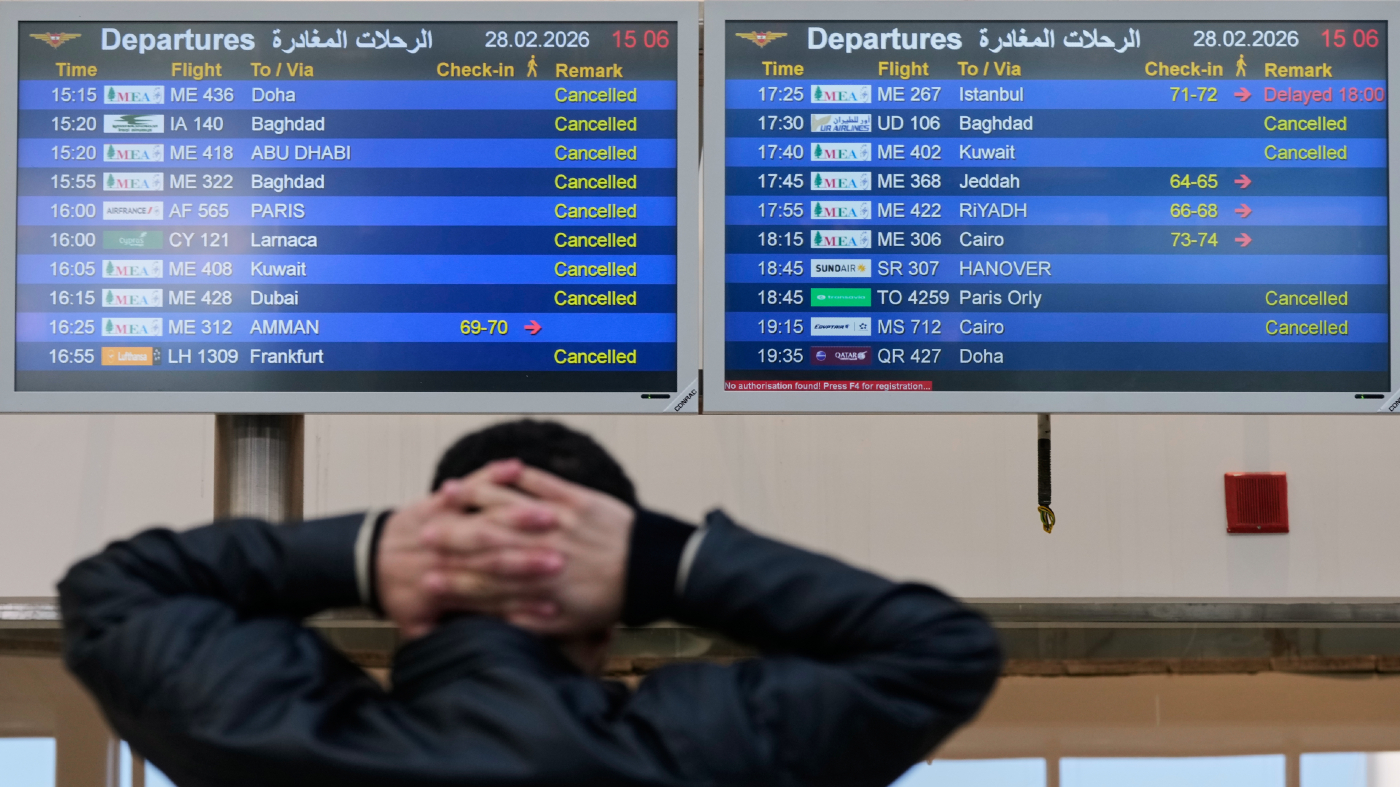
Governments around the world are racing to evacuate tens of thousands of citizens stranded in the Middle East, as major airlines suspend operations and regional airspace remains closed following the eruption of a devastating conflict.
The crisis, sparked by US-Israeli strikes on Iran and subsequent Iranian retaliation against US allies, has thrown global air travel into chaos. According to aviation data firm Cirium, at least 12,903 flights were cancelled between Saturday and Monday, representing 40% of planned departures and affecting an estimated more than one million passengers .
Key aviation hubs like Dubai International Airport, the world’s second-largest, have seen operations grind to a near-halt. While Dubai and Abu Dhabi resumed limited services on Monday, the cancellation rate remains as high as 93.5% . Airspace over Iraq, Israel, Kuwait, and Qatar is closed to civilian flights, forcing carriers to navigate complex and lengthy detours .
A Slow and Perilous Resumption
Despite the dangers, a trickle of flights have resumed. Emirates, flydubai, and Russia’s Aeroflot are operating some services, with aircraft immediately flying south out of the Gulf region to avoid conflict zones . Jordan, Saudi Arabia, and Oman have kept their airspace open, becoming vital lifelines for those seeking to escape.
Israel has announced its airspace will gradually reopen from Wednesday night, initially prioritizing flights repatriating its nationals .
International Repatriation Efforts Underway
Countries across Europe, Asia, and North America are mobilising to bring their citizens home. Here is a breakdown of the current evacuation efforts:
Europe Leads the Airlift
European nations have been quick to organise state-backed repatriation flights. The Czech Republic, Slovakia, and Romania have already airlifted hundreds of citizens. Two planes landed in Prague on Tuesday morning carrying around 100 Slovaks and over 300 Romanians who had transited through Egypt .
- France, which has an estimated 400,000 nationals in the region, has dispatched two flights to bring the first groups back to Paris .
- Germany has chartered a flight to leave Oman on Wednesday for some of its estimated 30,000 stranded citizens. Travel firm TUI is also flying home holidaymakers stuck on cruise ships in the Gulf .
- Spain confirmed that 175 citizens have departed Abu Dhabi on a scheduled flight bound for Madrid, with further flights planned from the UAE .
- The United Kingdom has announced a charter flight will bring nationals home from Oman in the coming days, as over 130,000 Britons in the region have registered with the Foreign Office .
- Italy is set to receive citizens on three flights arriving in Rome and Milan .
US and Other Nations Respond
- The United States is facilitating charter flights from Jordan, Saudi Arabia, and the UAE, reporting that over 9,000 Americans have already returned from the region since Saturday .
- Russia said it has picked up nationals who fled from Iran to Azerbaijan, as well as dozens more stranded in Egypt .
- India’s private sector is stepping in, with three carriers—IndiGo, Air India Express, and Akasa Air—announcing they will run evacuation flights .
“We Just Want to Get Home Safely”
For individual travellers, the ordeal has been terrifying and uncertain. Leela Rao, a US law student, managed to secure a seat on a flight from Abu Dhabi to Delhi, arriving just in time for a friend’s wedding. “I am feeling so, so, so grateful,” she told AP. “Everyone clapped when we landed” .
However, many remain stranded. Faizan Khalid, a Scottish resident travelling from Pakistan with his wife and infant daughter, saw his connecting flight via Dubai cancelled. With baby formula running low, he voiced the desperation felt by many: “We just want to get home safely” .
Others are resorting to extreme measures. One Dubai resident told the Daily Times she is planning a 33-hour journey by car and connecting flights via Oman and Saudi Arabia to reach Germany for her brother’s wedding .
Industry in Turmoil
The conflict has delivered a massive blow to the aviation and tourism industries, described as the biggest disruption since the COVID-19 pandemic . Airlines including Air France, British Airways, Finnair, and SAS have suspended flights to the Middle East for the coming days .
The ripple effects are being felt globally, with airfares on alternative routes, such as Hong Kong-London, skyrocketing. The surge in oil prices—with benchmark crude up roughly 30% this year—also threatens to squeeze airline profits further .
For now, the focus remains on the safe evacuation of hundreds of thousands of people trapped in a war zone, as nations work tirelessly to bring their citizens home through the few remaining open corridors in the sky.
 Maan
Maan